I’m very adaptable
I recently bought a Pentax 110 SLR camera and a selection of Pentax 110 lenses*. The camera was made in the late 70s/early 80s, and was advertised as the world’s smallest interchangeable lens SLR system. It was made for the 110 film size and 110 negatives are almost exactly the same size as the Four Thirds sensor in my Micro Four Thirds (MFT) cameras. This means that the lenses behave on MFT cameras just as they would on the original Pentax 110 body. All you need is a £20 Pentax 110 to MFT adapter.
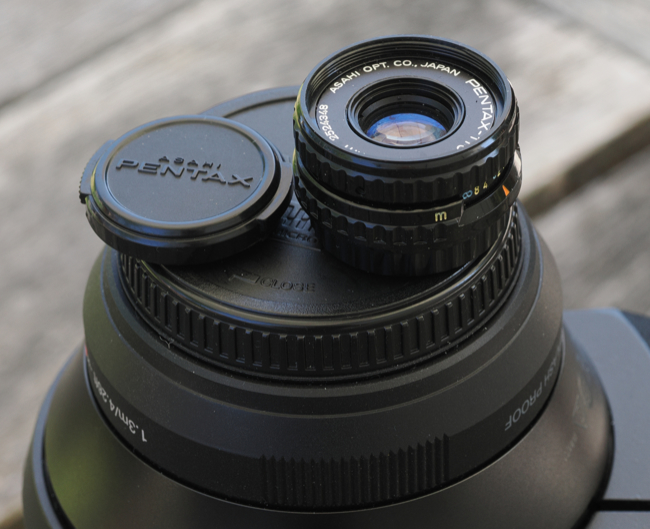
The lenses are all f2.8 aperture, and are very small indeed! Here’s the 24mm lens, the smallest, perched on the back of my OM System 100-400 MFT lens.
The lenses have no aperture diaphragms, so they are fixed at f2.8 on a MFT body. This can cause issues in bright sunlight, so you have to work round it.
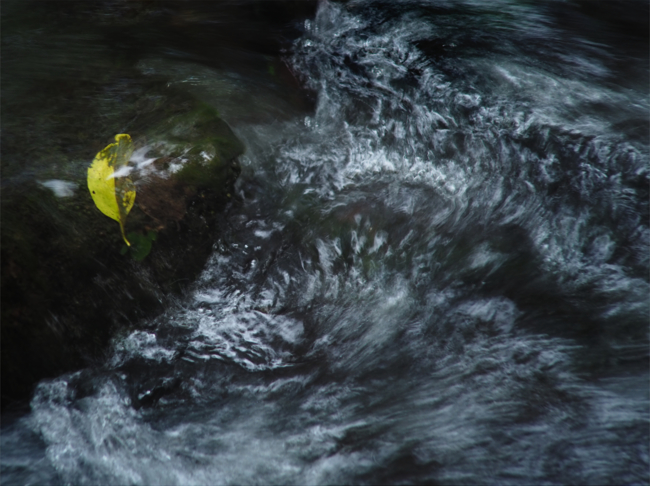
I went out for a walk with my Olympus E-M10 and the Pentax 110 70mm lens. The lenses are all manual focus, so I turned on Focus Peaking and set the +/- button to turn it on and off. My solution to the aperture issue was to find a shady valley with a lovely stream running through it. The rushing water contrasted well with a static yellow leaf on a rock.
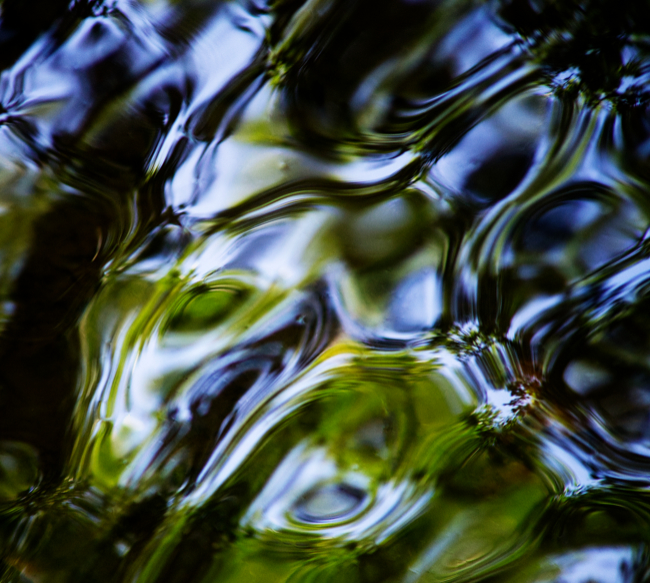
Some slower-moving water had soft ripples, with reflections of the sky and surrounding foliage. It made for a delightful abstract image with areas of blue and green.
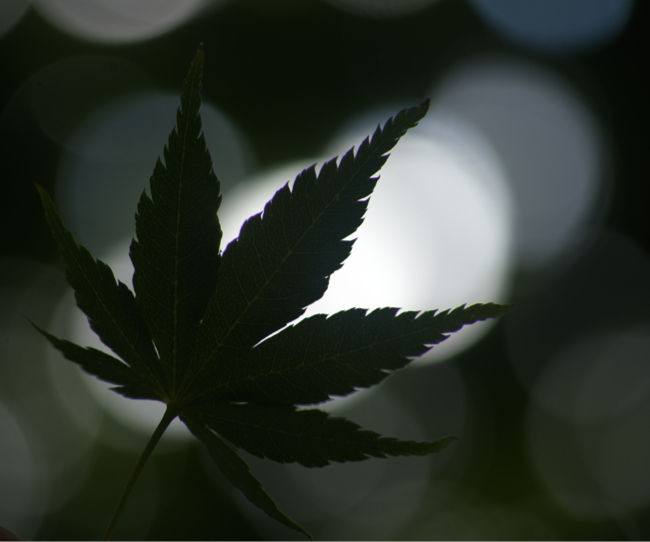
I wanted to play with the bokeh of the f2.8 lens aperture on the 70mm lens. The 70mm has a limited focus range, so I fitted an MFT extension tube to allow me to focus closer and throw the background out of focus more. I stood under our magnolia tree and held up a maple leaf against the light coming through the magnolia leaves. I focused on the maple leaf so the background was well out of focus. There’s a nice cluster of bokeh circles in the background.
It’s going to be fun trying out all the lenses; I’ll keep you up to date.
* 18mm, 20-40mm zoom, 24mm, 50mm and the 70mm.